Outdoor Spaces: Landscaping & Garden Design
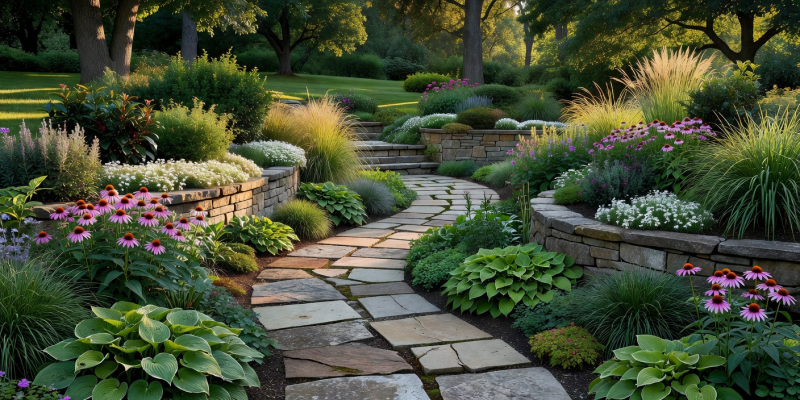
Transitioning from indoor pots to open-ground gardening introduces an immense shift in scale and variables. Outdoor landscaping is an exercise in creating ecosystems, requiring an understanding of hardiness zones, soil composition, sun mapping, and seasonal shifts. A well-planned garden offers curb appeal, increases property value, and acts as a sanctuary for both the homeowner and local wildlife.
Site Assessment and Sun Mapping
Before purchasing a single shrub, you must deeply understand your site. The most common error in landscaping is selecting plants based on visual preference rather than environmental compatibility. Begin by mapping your property's light exposure throughout the day. A garden bed might be in full shade during the morning but blasted with intense afternoon sun.
Categorize your spaces into:
- Full Sun: 6+ hours of direct sunlight. Ideal for most vegetables, fruit trees, and flowering perennials like coneflowers.
- Part Sun / Part Shade: 3 to 6 hours of sun, preferably in the cooler morning. Good for hydrangeas and many woodland edge species.
- Full Shade: Less than 3 hours of direct light. Suited for ferns, hostas, and astilbes.
Soil Health: The Foundation of Landscaping
Your soil is a living matrix of minerals, organic matter, water, air, and microorganisms. In outdoor gardening, you are primarily feeding the soil, which in turn feeds the plants. Determine whether your native soil leans toward heavy clay (poor drainage, high nutrients), sandy (excellent drainage, poor nutrient retention), or loamy (the ideal balance).
Regardless of your base soil type, top-dressing beds with organic compost annually is universally beneficial. Compost improves the aggregation of clay soils, enhancing drainage, while adding crucial water-holding capacity to sandy soils. Avoid excessive tilling, as this destroys the delicate fungal networks (mycorrhizae) that help plant roots access nutrients.
Structural Planting: Trees and Hardscaping
Successful landscape design relies on structure. Start your planning with the permanent elements. Hardscaping—patios, pathways, retaining walls, and pergolas—defines the geometry and flow of the space.
Next, place your "anchor" plants. Trees and large structural shrubs should be situated first, as they will dictate the shade patterns for decades to come. When planting trees, research their mature canopy width and root spread to avoid costly conflicts with foundations, power lines, and underground utilities.
Layering and Succession Planting
To avoid a flat, one-dimensional garden, employ the concept of layering. A mature border should have a canopy layer (small trees), a mid-layer (shrubs), an herbaceous layer (perennials), and a ground-cover layer. This mimics natural forest edges and maximizes ecological benefit.
Furthermore, plan for succession of bloom. A garden that explodes into color in May but remains completely barren by August lacks foresight. Incorporate evergreens for winter interest, early spring bulbs, summer-blooming perennials, and ornamental grasses that provide texture and movement deep into the autumn.
Native vs. Exotic Species
Incorporating native plants into your landscape design is increasingly recognized as best practice. Species indigenous to your region are evolutionarily adapted to local rainfall patterns, soil types, and temperature extremes, meaning they generally require less supplemental water and fewer chemical interventions once established. Crucially, they also form the base of the local food web, supporting native pollinators and bird populations far better than introduced exotic ornamentals.